
Showing posts with label Fight Diseases. Show all posts

Tuesday

Babesia - Treatment


Babesiosis is caused by a protozoa that infects red blood cells (erythrocytes).
The clinical features of babesiosis are similar to those of malaria and range in severity from asymptomatic to rapidly fatal. Most patients experience a viral infection–like illness with fever, chills, sweats, myalgia, arthralgia, anorexia, nausea, vomiting, or fatigue. On physical examination, fever, splenomegaly, hepatomegaly, or jaundice may be observed. Laboratory findings may include hemolytic anemia with an elevated reticulocyte count, thrombocytopenia, proteinuria, and elevated levels of liver enzymes, blood urea nitrogen, and creatinine. Complications of babesiosis include acute respiratory failure, disseminated intravascular coagulation, congestive heart failure, coma, and renal failure. Immunocompromised patients, such as those who lack a spleen, have a malignancy or HIV infection, or who exceed 50 years of age, are at increased risk of severe babesiosis. Approximately one-quarter of infected adults and one-half of children experience asymptomatic infection or such mild viral–like illness that the infection is only incidentally diagnosed by laboratory testing. In both untreated and treated patients, parasitemia may occasionally persist, resulting either in subsequent recrudescence weeks or months later (primarily in immunocompromised hosts) or, rarely, in transmission of the pathogen to others through blood transfusion.
  

Physiotherapeutic Device BIOMEDIS on Android Platform (model 2015)


Physiotherapeutic Device BIOMEDIS  on Android Platform (model 2015)
The medical device "Biomedis" is indicated for administering of low frequency electromagnetic therapy, treatment, prevention and rehabilitation.
» Buy

Friday

Lyme Disease Treatment

Lyme Deseas Sources: Mayo Clinic
Lyme disease is a bacterial infection you get from the bite of an infected tick. The germ (bacterium) that causes Lyme disease lives in certain animals. These are mainly rodents such as mice, some birds and some other small animals. The bacterium is usually harmless to the animals.

Ticks are small insect-like creatures, about the size of a pinhead. Ticks feed by biting the skin and sucking blood from animals such as mice, and sometimes humans. In this way, some ticks get infected with the bacterium that causes Lyme disease.

Ticks cannot jump or fly, but climb on to passing humans from long grass or foliage. If an infected tick bites a human, then the bacteria may be passed into the human. The bacterium that causes Lyme disease is not passed from person to person. Note: most ticks in the UK are not infected by the bacterium that causes Lyme disease. Therefore, most tick bites will not cause Lyme disease.

After a human has been bitten by a tick, it usually takes 24-48 hours for the bacteria in the tick to pass into the human. (Ticks are tiny and 'cling on' to you once they bite you. They then suck blood and become swollen ('engorge') with blood which they feed off. The bacteria are normally carried in their gut, and only travel up to their mouth and into your skin once they have been fed and are engorged. This normally takes about 24 hours, but can be less if the tick was already partially fed.) Therefore, if you remove a tick soon after being bitten - within 24 hours - you are much less likely to develop Lyme disease, even if it was an infected tick.

So, it is only certain ticks, that are infected, that bite, and are not noticed clinging on to the skin, that cause Lyme disease. However, ticks are very small, and often do not hurt when they bite so it is quite easy to have a tick bite without noticing. Many people who develop Lyme disease cannot remember being bitten by a tick.

Once bacteria are passed from the infected tick into your skin, they then multiply and travel in the bloodstream to other parts of the body to cause symptoms. The parts of the body that are mainly affected by this bacteria are the skin, joints, nerves and heart.

The first symptom is usually a rash, which may look like a bull's eye. As the infection spreads, you may have

Other signs and symptoms that may be associated with Lyme disease include the following:
Chills
Dizziness
Fever
Joint Swelling
Loss of Facial Muscle Tone
Swollen Lymph Nodes
Memory Problems
Muscle Pains
Numbness
Palpitations
Shooting Pains
Stiff Neck
Tingling

Some people may experience the following related Lyme disease symptoms and signs:
Rash
Joint Pain
Headache

Here are some more details:

Erythma migrans. Erythema migrans is the telltale rash which occurs in about 70% to 80% of cases and starts as a small red spot that expands over a period of days or weeks, forming a circular, triangular, or oval-shaped rash. Sometimes the rash resembles a bull's-eye because it appears as a red ring surrounding a central clear area. The rash, which can range in size from that of a dime to the entire width of a person's back, appears between three days and a few weeks of a tick bite, usually occurring at the site of a bite. As infection spreads, several rashes can appear at different sites on the body.
Erythema migrans is often accompanied by symptoms such as fever, headache , stiff neck, body aches, and fatigue . These flu -like symptoms may resemble those of common viral infections and usually resolve within days or a few weeks.
Arthritis. After several weeks of being infected with Lyme disease, approximately 60% of those people not treated with antibiotics  develop recurrent attacks of painful and swollen joints that last a few days to a few months. The arthritis can shift from one joint to another; the knee  is most commonly affected and usually one or a few joints are affected at any given time. About 10% to 20% of untreated patients will go on to develop lasting arthritis. The knuckle joints of the hands are only very rarely affected.
Neurological symptoms. Lyme disease can also affect the nervous system, causing symptoms such as stiff neck and severe headache  (meningitis), temporary paralysis of facial muscles (Bell's palsy), numbness, pain or weakness in the limbs, or poor coordination. More subtle changes such as memory loss, difficulty with concentration, and a change in mood or sleeping habits have also been associated with Lyme disease. People with these latter symptoms alone usually don't have Lyme disease as their cause.
Nervous system abnormalities usually develop several weeks, months, or even years following an untreated infection. These symptoms often last for weeks or months and may recur. These features of Lyme disease usually start to resolve even before antibiotics  are started. Patients with neurologic disease usually have a total return to normal function.
Heart problems. Fewer than one out of 10 Lyme disease patients develops heart problems, such as an irregular, slow heartbeat, which can be signaled by dizziness or shortness of breath. These symptoms rarely last more than a few days or weeks. Such heart abnormalities generally appear several weeks after infection, and usually begin to resolve even before treatment.
Other symptoms. Less commonly, Lyme disease can result in eye  inflammation and severe fatigue , although none of these problems is likely to appear without other Lyme disease symptoms being present.

Lyme disease can be hard to diagnose because you may not have noticed a tick bite. Also, many of its symptoms are like those of the flu and other diseases.


Bioresonance therapy can cure most cases of Lyme disease. The sooner treatment begins, the quicker and more complete the recovery.

Physiotherapeutic Device BIOMEDIS on Android Platform (model 2015)


Physiotherapeutic Device BIOMEDIS  on Android Platform (model 2015)
The medical device "Biomedis" is indicated for administering of low frequency electromagnetic therapy, treatment, prevention and rehabilitation.
» Buy

The Candida Treatment Program For the Biomedis Android device

http://a-ll.dk/index.htm
Biomedis Android
 Candidiasis, also known as Candida, Invasive Candidiasis and Systemic Candidiasis are "systemic infections".  Candida in the mouth is called Thrush. 
Candida (also called Candida Yeast) is a fungal infection. 
An infection which has spread to other parts of the body is known as a "systemic infection"  (throughout the system). 
The bloodstream is used as the highway to other parts of the body.
The infection can take place in any part of the body, producing various types of symptoms.  
Infections must be removed from all parts of the body in order to regain or achieve good health. 
Infection removal must be accomplished from the inside out, via the bloodstream for a period of at least several months, in order to be effective.  The infection must be killed throughout the entire body. 
We have several guidelines here on our website to help you gain the necessary knowledge to rid yourself of this very common infection.  


The Candida Treatment Program  For the Biomedis Android device


NATURAL CURE FOR FUNGUS, CANDIDA, YEAST
All skin fungal infections respond well to the Candida Program recommended. Therefore, as with all other fungal infections, the main treatment is the Candida diet, supplements, antifungals and probiotics.
There are some direct treatments which can help relieve symptoms to some degree:
  1. Avoid using scented or antibacterial soaps, instead use a good quality coconut oil based soap, available at the health store, or wash thoroughly with plain water.
  2. After washing or bathing, rinse the area well with an apple cider vinegar or lemon juice and water mixture (mix 2 tablespoons of apple cider vinegar or the juice of 1/2 lemon into 2 cups of warm water). Or use spritzer containing these solutions, and spray the entire area completely, to replenish the acid layer to the skin. Pat it dry, but do not rinse it off. Any smell dissipates quickly. This restores the natural acid layer of the skin which helps fight fungal infections.
  3. Wear 100% cotton loose fitting clothing and nightwear. Do not wear tight fitting clothing made of synthetic fibres. Natural fibres allow the skin to breathe like it should.
  4. Rub coconut oil into the affected areas as often as possible, alternating with baking soda which is patted or dusted on.
  5. Baking soda paste can be applied directly to areas affected as well. Put a little water in a small dish and add baking soda to make a pasty consistency.
  6. Taking baking soda, or baking soda combined with epsom salt, baths helps all skin problems. Add 1/2 cup or more of baking soda to your bath water, or use 1/2 cup of baking soda and 1/2 cup of epsom salt.
  7. Twice a day rub antifungal solutions well into all areas that are affected (use 1 tablespoon of coconut oil with 4-5 drops of one of the following (or use a combination): 1) tea tree oil, 2) garlic oil, 3) oil of oregano, and 4) clove oil. For nails there is no need to dilute these oils, just apply them directly, rubbing well into the area around the nail and under the nail.

    You make these mixtures ahead of time; there is no need to refrigerate them. Multiply the amount of coconut oil as well as the number of drops accordingly.

    You can also try rubbing the oils full strength into affected areas, but if the skin is broken or oozing it may sting for awhile or feel like it is burning. However, none of these oils actually burn the skin but they do generate heat which is part of their healing affect.

Wednesday

Parkinson's Disease, Epilepsy, Muscle spasms

Parkinson's disease (or, simply, Parkinson's) is the most common form of parkinsonism, a group of motor system disorders. It is a slowly progressing, degenerative disease that is usually associated with the following symptoms, all of which result from the loss of dopamine-producing brain cells:
  • Tremor or trembling of the arms, jaw, legs, and face
  • Stiffness or rigidity of the limbs and trunk
  • Bradykinesia (slowness of movement)
  • Postural instability, or impaired balance and coordination
Dopamine is a substance produced in the body that has many effects, including smooth and coordinated muscle movement.


COMPLEX FOR  the "BIOMEDIS Android" , "BIOMEDIS MINI" devices:

http://a-ll.dk/index.htmhttp://a-ll.dk/index.htm

In Parkinson's disease and epilepsy, you must first perform a program to restore the memory and only then start the COMPLEX .
Even when the diagnosis of Parkinson's disease or epilepsy can not be ruled out any program blocks. Only the consistent implementation of all blocks can provide efficiency program, regardless of the formulation of a diagnosis.

FIRST STAGE - 5 DAYS:
Cramps.
Number of frequencies: 4.
Frequencies: 33.5, 54, 64, 70.5
 - 20 minutes.
Cramps headache.
Number of frequencies: 4.
Frequencies: 33.5, 54, 64, 70.5
 - 20 minutes.
Muscle cramps.
Number of frequencies: 2.
Frequencies: 6.8, 33.5
- 10 minutes.
Spastic convulsions.
Number of frequencies: 3.
 Frequency: 9.19, 8.25, 7.69
 - 6 min.


SECOND STAGE - 5 DAYS:
Epilepsy (see Shigella).
Number of frequencies: 21.
Frequencies: 10000; 1550 953, 880, 832, 802, 787, 770, 769, 762, 727, 700, 650, 633, 621, 600, 226, 210, 125, 20, 7.83
 - 1 hour 3 minutes.
Epilepsy attack.
Number of frequencies: 8.
Frequencies: 20, 727, 787, 880, 120, 329, 226, 953
 - 16 minutes.
Epilepsy
Number of frequencies: 3.
Frequency: 12, 37, 90
- 15 min.


THIRD STAGE- 5 DAYS:
Parkinsonism.
Number of frequencies: 5.
 Frequencies: 3.5, 88.5, 95.5, 96.5, 100
 - 25 minutes.
Parkinson's disease.
Number of frequencies: 28. Frequency: 6000; 5000; 4334; 3176; 1422; 1131; 871, 840, 827, 813, 744, 742, 733, 693, 658, 611, 577, 569, 531, 524, 470, 442, 314, 310; 172, 134, 33, 1.1
 - 1 hour 24 minutes.


FOURTH STAGE - 5 DAYS
Removing parkinsonian tremor.
Number of frequencies: 4.
Frequency: 6000; 470; 130; 169
 - 20 minutes.
Sedation, sedation.
Number of frequencies: 3.
 Frequency: 3.9, 5.5, 6.3.
15 minutes.
Center of balance.
Number of frequencies: 2.
 Frequencies: 30, 97.5
 - 10 minutes.
Muscle twitching, fasciculation.
Number of frequencies: 3.
Frequencies: 28, 28.5, 33.5
 - 15 minutes.
General Course - twenty days, repeat cycle after a ten-break.

Tuesday

Treatment of Giardia infections


Giardia is a parasitic protozoan flagellate. Giardia is common in all parts of the world and the incidence is infection is high: one in five people in the world is infected with giardia, and this figure increases considerably every year. Giardia prevalence among children varies from 27-70%.
Humans are the source of infection (patient or carrier). Infection occurs through the mouth by ingestion of food or water contaminated with giardia, and when passing giardia to the mouth with dirty hands. It has been established that the chlorine, most commonly used for water purification, does not have any destructive effects on giardia cysts.
The disease caused by giardia is called giardiasis. Giardia parasites live in the small intestine, bile ducts and gall bladder. Once in the gastrointestinal tract, they multiply very quickly, irritating the mucous membrane.
Giardia exists in two forms: vegetative (mobile) and in the form of cysts.


Symptoms                            

When people are infected with giardia, there is pain in the upper abdomen, around the navel, rumbling and bloating of the stomach. There may be constipation alternating with diarrhea (the feces are yellow with mucus). Giardiasis can cause duodenitis, pancreatitis, enteritis, hepatitis and cholecystitis,a manifestation of the disease of local character. Often giardiasis hepatitis is observed: liver enlargement and induration. Often it is associated with lesions of the pancreas.
Giardiasis is often accompanied by symptoms of intoxication: fatigue, tearfulness, lethargy, headaches and depression.
This may be due to the decay of giardia and accumulation of their metabolic products in the bowel. Often allergies, joint pain, itching and fever is observed.
Diagnostics include microscopy of the stool or duodenal contents to detect giardia cysts. In chronic forms, the excretion of cysts is periodic, so to confirm the diagnosis, it is recommended
to test the feces 3-4 times at various intervals (7-8 days).

Life Cycle

                           
Picture of life cycle (http://www.google.com/


The influence of electromagnetic fields on Giardia parasites

This problem can be solved with DETA-AP devices:

 
Not medicine at all, just the device and lots of water to flush the Giardia out of your system.

Application:

The “Giardia” program is intended for the treatment of giardiasis. It should be carried out at intervals of 1-3 days for 1 month (10-15 times). The frequency of application depends on the state of health after carrying out repetition of the program.
Treatment programs:
1. Protozoa;
2. Giardia;
3. ......
4. .....
5. .....
6. .....
7. .....
(Become Our Client and get the Treatment programs)

If after repeated sessions there is pain in the left upper quadrant, the interval between sessions should be increased.
For the purpose of detoxification, “Drainage therapy” is recommended after the treatment program. It can be applied several times daily, as required. A prerequisite for carrying out drainage therapy is to drink plenty of clean, a non-carbonated and unboiled water, equivalent to not less than 30 ml. per kilogram body weight per day.
The criteria for being cured is the disappearance of giardia cysts in the stools or duodenal contents after treatment. It is recommended that testing is carried out 3-4 times at various intervals (7-8 days).


The antenna is located on the back of the unit. Range of the instrument of 1.5 m. For the device to take effect, place the device with the keys facing away from you at a distance of not more than 0.5 m, e.g. in your breast pocket.

The instrument work automatically. All programs will be activated one after another. The device should be turned on once a day and placed near you while programs do the work. You can either turn on the device in the morning and hang it on the belt or neck or place it with you in bed before you go to sleep. http://a-ll.dk/shop/default.htm

Wednesday

ANGINA (OR TONSILLITIS)

OVERVIEW

Inflammation of tonsils is called Tonsillitis. Tonsillitis can be viral and bacterial. Inflammation of the tonsils (or tonsillitis) is also called Angina (not Angina Pectoris, which is a heart/chest disease), usually a bacterial etiology. This disease has a number of complications and therefore requires mandatory treatment under the supervision of a therapist. Catarrhal Angina (inflammation without pus) is less common.

WHAT CAUSES ANGINA

Angina is caused by bacteria streptococci (90% of cases) or staphylococci (less than 10%). It is a contagious disease; the source of infection may be the patient himself or any other carrier. Contamination often occurs through airborne droplets, although it is also possible by alimentary transmission, for example, using the same dish. Therefore, if a family member is ill with tonsillitis, he should be isolated, and his personal dishes separated at the time of the disease.

SYMPTOMS OF ANGINA

•A sharp and severe pain in the throat, that worsens on swallowing
 •High body temperature (39-40 C)
 •General weakness, headache
 •Swollen lymph nodes, which are palpated under the lower jaw close to the neck
 •Children (especially young) express other characteristic symptoms such as not eating, drooling and pain in the ears.

In lacunar tonsillitis, tonsils are enlarged in size, red, covered with white bloom formed by pus in the gaps of the tonsils; and in follicular tonsillitis, tonsils are red, covered with pale yellow bubbles, like grains of rice.

DIAGNOSIS

Diagnosis of Angina based on clinical symptoms of the disease; in some cases, your doctor may also carry out check for Diphtheria.

TREATING ANGINA BY USIND THE DEVICE “DETA”

Angina can be successfully treated by medical devices of electromagnetic therapy “Deta-Ritm”and "Deta-Ap".

Deta-Ritm:

All customers who have purchased Deta devices over www.a-ll.dk can always count on the personal support and treatment programs.

1. A...;
2.Chronic tonsillitis;
3.T...;
4.T...;
5.I...;
6.I...;
and always
7.D....

The program "Chronic tonsillitis" is effective for both prevention and treatment of tonsillitis. Just turn on the DETA-RITM device and put into a pocket.
The mode "Chronic tonsillitis" is used in convenient time. If it is necessary, repeat the session in half an hour.

Deta-AP: 


1. Sta....;
2. C...;
3. C...;
4. M...;
5. Staph;
6. C...;
7. S...s;
8. S...n;
9. D...
every 4 hours.

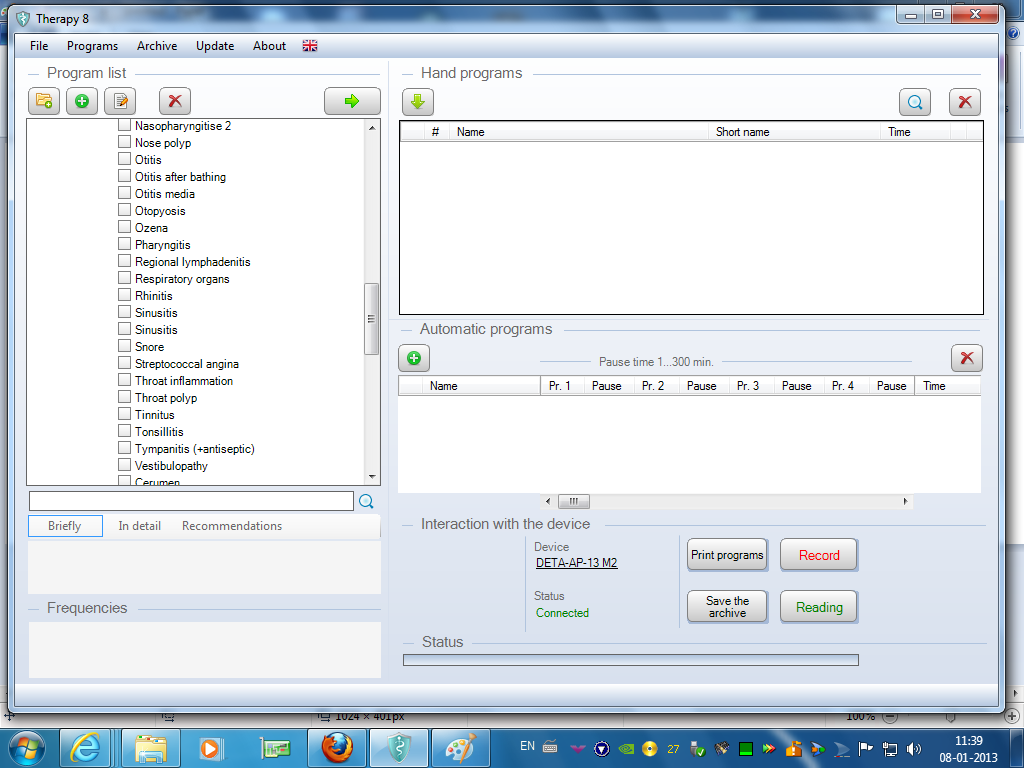
Electronic reference programs Therapy 8.0 set for Deta-AP and Deta-Ritm programming


Therapy 8.0 includes more than 3000 applications for various diseases. The programmer is required to delete old and add new programs to devices "DETA -RITM" and "DETA-AP". The process of programming is extremely simple and takes 3-5 minutes.


Angina (or tonsillitis) Therapy Programs:


Sunday

Malaria


The word malaria comes from 18th century Italian mala meaning "bad" and aria meaning "air". Most likely, the term was first used by Dr. Francisco Torti, Italy, when people thought the disease was caused by foul air in marshy areas. It was not until 1880 that scientists discovered that malaria was a parasitic disease which is transmitted by the anopheles mosquito. The mosquito infects the host with a one-cell parasite called plasmodium. Not long after they found out that Malaria is transmitted from human-to-human through the bite of the female mosquito, which needs blood for her eggs.
Malaria parasites are from the genus Plasmodium (phylum Apicomplexa). In humans, malaria is caused by P. falciparum, P. malariae, P. ovale, P. vivax and P. knowlesi. Among those infected, P. falciparum is the most common species identified (~75%) followed by P. vivax (~20%). P. falciparum accounts for the majority of deaths; non-falciparum species have been found to be the cause of about 14% of cases of severe malaria in some groups. P. vivax proportionally is more common outside of Africa.There have been documented human infections with several species of Plasmodium from higher apes; however, with the exception of P. knowlesi—a zoonotic species that causes malaria in macaques—these are mostly of limited public health importance.

The female Anopheles mosquito transmits the parasite to a human when it takes a blood meal - it bites the human in order to feed on blood. Only the female Anopheles mosquito can transmit malaria, and it must have been infected through a previous blood meal taken from an infected human. When the mosquito bites an infected person a minute quantity of the malaria (plasmodium) parasite in the blood is taken. Approximately one week later that same infected mosquito takes its next blood meal. The plasmodium parasites mix with the mosquito's saliva and are injected into the host (human being).

As the parasite exists in human red blood cells, malaria can be passed on from one person to the next through organ transplant, shared use of needles/syringes, and blood transfusion. An infected mother may also pass malaria on to her baby during delivery (birth) - this is called 'congenital malaria'.
Malaria infection develops via two phases: one that involves the liver or hepatic system (exoerythrocytic), and one which involves red blood cells, or erythrocytes (erythrocytic). When an infected mosquito pierces a person's skin to take a blood meal, sporozoites in the mosquito's saliva enter the bloodstream and migrate to the liver where they infect hepatocytes, multiplying asexually and asymptomatically for a period of 8–30 days.

Afer a potential dormant period in the liver, these organisms differentiate to yield thousands of merozoites, which, following rupture of their host cells, escape into the blood and infect red blood cells to begin the erythrocytic stage of the life cycle. The parasite escapes from the liver undetected by wrapping itself in the cell membrane of the infected host liver cell.

Within the red blood cells, the parasites multiply further, again asexually, periodically breaking out of their hosts to invade fresh red blood cells. Several such amplification cycles occur. Thus, classical descriptions of waves of fever arise from simultaneous waves of merozoites escaping and infecting red blood cells.

Some P. vivax sporozoites do not immediately develop into exoerythrocytic-phase merozoites, but instead produce hypnozoites that remain dormant for periods ranging from several months (6–12 months is typical) to as long as three years. After a period of dormancy, they reactivate and produce merozoites. Hypnozoites are responsible for long incubation and late relapses in P. vivax infections, although their existence in P. ovale is uncertain.

The parasite is relatively protected from attack by the body's immune system because for most of its human life cycle it resides within the liver and blood cells and is relatively invisible to immune surveillance. However, circulating infected blood cells are destroyed in the spleen. To avoid this fate, the P. falciparum parasite displays adhesive proteins on the surface of the infected blood cells, causing the blood cells to stick to the walls of small blood vessels, thereby sequestering the parasite from passage through the general circulation and the spleen. The blockage of the microvasculature causes symptoms such as in placental and cerebral malaria. In cerebral malaria the sequestrated red blood cells can breach the blood–brain barrier possibly leading to coma.

The main symptom of malaria is a fever that occurs in regular episodes, with sweating and shivers (known as rigors), and exhaustion (because of anaemia). In some cases, it can affect the brain or kidneys.

The treatment is provided by the device of electromagnetic therapy “DETA-AP”.

All customers who have purchased Deta devices over www.a-ll.dk can always count on the personal support and treatment programs. 

Main problem-related programs:

  1.  Malaria
  2.  Malaria Falciparum
The treatment programs should be applied during acute course of disease up to 3-4 times a day until the disappearance of clinical symptoms(3-4 days or 1 week).
The criteria of the end of the healing period are the disappearance of the symptoms of the disease and negative lab test results, which were conducted a month after the end of the treatment.
For preventing malaria should be applied the programs daily 1 time.
 

Supplemental:

  1. A... ;
  2. P... ...a
  3. S... .. ... ..... .....;
  4. F... ;
  5. L... ...;


Saturday

How to Stop Snoring


Just about everyone snores occasionally, but if snoring happens frequently it can affect the quantity and quality of your sleep and that of other family members. Snoring can lead to poor sleep and daytime fatigue, irritability, and increased health problems. If your snoring keeps your partner awake, it can also create major relationship problems. Thankfully, sleeping in separate bedrooms isn’t the only remedy for snoring. There are many other effective solutions available.
Snoring happens when you can't move air freely through your nose and mouth during sleep. It’s caused by a narrowing of your airway, either from poor sleep posture or abnormalities of the soft tissues in your throat. A narrow airway gets in the way of smooth breathing and creates the sound of snoring.

Don’t let snoring damage your relationship - Use the DETA-Ritm device.

Course of treatment: Sessions for 2 weeks with a one week break between them. Until breathing is fully restored and snore has disappeared.
The interval between application of programs should be not less than an hour unless additional instructions are provided!

The limit per day is no more than 6 programs ('Body detox'' can be an  exception and may be used as the 7th program)
  •  Morning  - “Active protection”
  •  10am – 12pm – “Blood circulation regulation”
  •  11am – 1pm – “Regulation of gastrointestinal tract“
  •  1pm – 3pm – “Paranasal sinus”
  •  5pm – 7pm  - “Breathing centre”
  •  7pm – 9pm – “Snore”
  •  Before sleep  - “Body detox”

 Main problem-related programs:
  •  Active protection
  •  Blood circulation regulation.
  •  Regulation of gastrointestinal tract
  •  Paranasal sinus.
  •  Breathing centre.
  •  Snore
  •  Body detox

Supplemental:
  •  Chronic fatigue syndrome.
  •  Antistress (Sleeping disorder)
  •  Internal anxiety.
  •  Supersensitivity of the nervous system.
  •  Cold.
  •  Dizziness.
  •  Regulation of female urinogenital system.
  •  Regulation of male urinogenital system.

 
By healing and developing people using innovative technologies today, we make the world better tomorrow.
Wireless Electromagnetic Field Therapy Devices. Wireless disease treatment without drugs and surgery.

Wireless electromagnetic treatment devices are intended to arouse and supplement dormant reserves in the body and to reveal and destroy parasites and viruses.

Popular Posts